
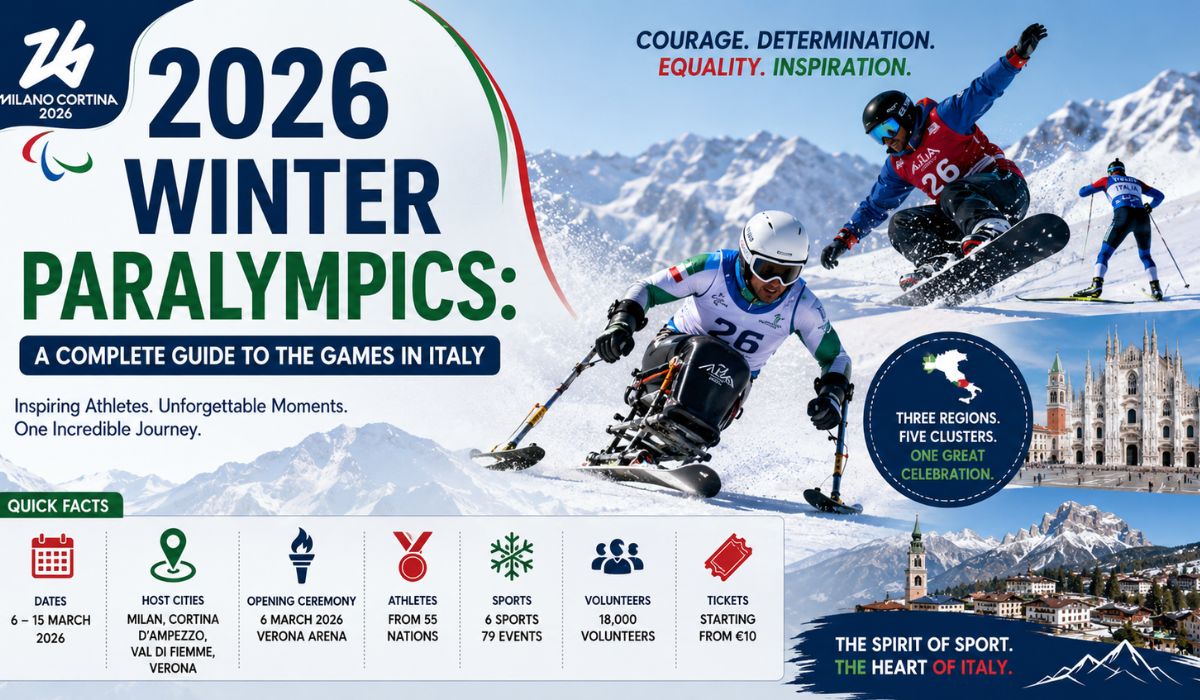
The 2026 Winter Paralympics brought the world’s best Para athletes together for one of the most inspiring sporting events of the year. Hosted across Northern Italy, the Games showcased elite competition, remarkable personal stories, and the continuing growth of adaptive winter sports. Held from 6 March to 15 March 2026, with Wheelchair Curling beginning on 4 March, the event marked the 14th edition of the Winter Paralympic Games and celebrated the 50th anniversary of the first Winter Paralympics held in 1976.
Known officially as the Milano Cortina 2026 Winter Paralympic Games, the event was spread across the regions of Lombardy, Veneto, and Trentino-Alto Adige/Südtirol. Thousands of athletes, volunteers, officials, and fans participated in a celebration of excellence, determination, and inclusion. This guide explores everything readers need to know about the 2026 Winter Paralympics, from host cities and venues to medal winners, memorable moments, and the lasting legacy of the Games.
What Were The 2026 Winter Paralympics?
The Winter Paralympic Games are the highest-level international competition for athletes with physical disabilities who compete in winter sports. Organized by the International Paralympic Committee, the Games are held every four years shortly after the Winter Olympics.
The 2026 Winter Paralympics were especially meaningful because they marked half a century since the first Winter Paralympics took place in Sweden in 1976. The Games featured six sports and seventy-nine medal events, bringing together athletes from fifty-five National Paralympic Committees. Beyond the competition, the event highlighted the importance of accessibility, diversity, and equal opportunities in sport.
How Italy Became The Host
Italy secured the right to host the Games after a successful bid by Milan and Cortina d’Ampezzo. The proposal emphasized sustainability, existing sports infrastructure, and Italy’s experience in hosting major international events.
The winning bid defeated Stockholm–Åre of Sweden during the International Olympic Committee voting session held in Lausanne, Switzerland, in June 2019. The decision awarded Italy both the 2026 Winter Olympics and the 2026 Winter Paralympics. This marked the third time Italy hosted a Paralympic Games, following Rome in 1960 and Turin in 2006.
Host Cities And Competition Venues
Unlike many previous editions, the Games were spread across several clusters rather than a single city. This approach allowed organizers to use existing world-class facilities while reducing construction costs.
Milan hosted Para Ice Hockey and served as a major operational center. Cortina d’Ampezzo welcomed Para Alpine Skiing, Para Snowboard, and Wheelchair Curling events. Val Di Fiemme hosted Para Biathlon and Para Cross-Country Skiing competitions. Verona played a special role by hosting the opening ceremony in its historic arena.
The use of multiple locations showcased Italy’s beautiful mountain landscapes while providing athletes with high-quality competition venues.
Sports And Events
The 2026 Winter Paralympics featured six official sports. These disciplines represented a wide range of athletic skills, from speed and endurance to teamwork and technical precision.
Para Alpine Skiing remained one of the most popular sports, featuring visually impaired, standing, and sitting classifications. Para Biathlon combined cross-country skiing with target shooting, demanding both endurance and accuracy. Para Cross-Country Skiing tested athletes over various distances and techniques.
Para Snowboard continued its rapid growth, attracting exciting competition and younger audiences. Para Ice Hockey delivered intense team action, while Wheelchair Curling highlighted strategy and precision. A Mixed Doubles Wheelchair Curling event made its Paralympic debut, adding a fresh dimension to the competition program.
The Paralympic Torch Relay
The torch relay represented one of the most symbolic elements of the Games. The Paralympic flame was lit at Stoke Mandeville Hospital in the United Kingdom, the birthplace of the Paralympic Movement.
The relay ran from 24 February to 6 March 2026. More than five hundred torchbearers carried the flame across approximately two thousand kilometers. The route connected several Italian cities before reaching Verona for the opening ceremony.
The torch itself, named Essential, reflected sustainability and innovation. Made primarily from recycled materials, it used renewable bio-LPG fuel and could be refilled multiple times, reducing waste and supporting environmental goals.
Opening Ceremony Highlights
The opening ceremony took place at Verona Arena on 6 March 2026. The event was themed Life In Motion and celebrated human resilience, creativity, and achievement.
Athletes from participating nations were introduced to a global audience, while artistic performances highlighted Italian culture and the values of the Paralympic Movement. The Paralympic cauldrons were lit by Italian Paralympians Gianmaria Dal Maistro and Francesca Porcellato, creating one of the most memorable moments of the evening.
The ceremony emphasized inclusion and the power of sport to unite people from different backgrounds and cultures.
Nations And Athletes
Fifty-five National Paralympic Committees qualified athletes for the Games. The participation reflected the continued growth of Winter Paralympic sports around the world.
Several countries made their Winter Paralympic debut, including El Salvador, Haiti, Montenegro, North Macedonia, and Portugal. Their presence demonstrated the expanding global reach of adaptive winter sports.
A total of 665 athlete quota places were available. Competitors represented every level of Paralympic sport, from experienced champions to first-time participants hoping to make history.
Medal Table And Top Nations
China finished first in the medal standings for the second consecutive Winter Paralympics. Chinese athletes won fifteen gold medals and forty-four total medals, confirming the nation’s growing strength in adaptive winter sports.
The United States finished second with thirteen gold medals and twenty-four total medals. Russia placed third with eight gold medals. Host nation Italy achieved one of its best performances ever by finishing fourth and earning sixteen total medals.
Several countries exceeded expectations, while others celebrated personal bests and breakthrough performances that inspired future generations of athletes.
Historic Achievements And Standout Performers
One of the most significant stories came from Brazil. Cristian Ribera won a silver medal, giving Brazil its first Winter Paralympic medal. The achievement also made Brazil the first South American, Latin American, and tropical nation to earn a Winter Paralympic medal.
Latvia also celebrated history by winning its first Winter Paralympic medal through the Mixed Doubles Wheelchair Curling competition.
Several athletes emerged as stars of the Games. Austria’s Veronika Aigner, American champion Oksana Masters, and multiple medal-winning athletes from China, Italy, and South Korea delivered outstanding performances that captured worldwide attention.
Branding And Mascots
The visual identity of Milano Cortina 2026 reflected both modern design and Italian culture. The official emblem, called Futura, featured a clean and recognizable design used for both the Olympics and Paralympics.
The Paralympic mascot, Milo, became one of the most recognizable symbols of the Games. Milo is a brown stoat born without a leg who learns to use his tail creatively. The character represents determination, ingenuity, and resilience, values that align closely with the Paralympic spirit.
The official song, Fino All’Alba, further strengthened the event’s identity and was used throughout promotional campaigns and ceremonies.
Broadcasting And Global Reach
The Games reached audiences around the world through extensive television and digital coverage. Broadcasters provided hundreds of hours of live programming, athlete interviews, and behind-the-scenes content.
Growing media attention reflected the increasing popularity of Paralympic sports. Fans were able to follow competitions through traditional television broadcasts, online streaming platforms, and social media channels.
This expanded visibility helped introduce new audiences to Paralympic athletes and encouraged greater awareness of adaptive sports worldwide.
Challenges And Controversies
Like many major international sporting events, the 2026 Winter Paralympics faced several challenges. One of the most debated issues involved the participation of Russian and Belarusian athletes. Their inclusion generated political discussions and led some delegations to boycott ceremonial events.
Weather conditions also attracted attention. Mild temperatures and limited natural snowfall forced organizers to rely heavily on snowmaking systems. Some athletes raised concerns about course conditions, particularly in Alpine Skiing competitions.
Additionally, international geopolitical tensions affected participation, including the withdrawal of Iran’s only qualified athlete due to travel complications related to regional conflict.
The Legacy Of Milano Cortina 2026
The impact of the 2026 Winter Paralympics extends far beyond medals and rankings. The Games strengthened Italy’s reputation as a host of major sporting events while promoting accessibility and inclusion.
Investment in sports infrastructure, transportation, and accessibility improvements will continue benefiting local communities for years to come. The event also inspired a new generation of athletes with disabilities to pursue winter sports and compete at the highest level.
Perhaps most importantly, Milano Cortina 2026 demonstrated how sport can bring people together despite political, cultural, and geographical differences.
Why The 2026 Winter Paralympics Matter
The significance of the 2026 Winter Paralympics goes beyond competition results. These Games highlighted remarkable athletic performances while continuing to challenge stereotypes and expand opportunities for athletes with disabilities.
The event showed how adaptive sports continue to evolve, attract larger audiences, and gain greater international recognition. With new nations participating, record-breaking performances, and growing media coverage, the Winter Paralympic Movement appears stronger than ever.
As the Paralympic community looks ahead to future Games, Milano Cortina 2026 will be remembered as a milestone event that celebrated excellence, inclusion, and human potential.
Conclusion
The 2026 Winter Paralympics delivered an inspiring celebration of athletic achievement, determination, and inclusion. From the mountains of Cortina d’Ampezzo to the historic arena of Verona, the Games showcased the very best of Winter Paralympic sport. Historic firsts for Brazil and Latvia, China’s continued success, Italy’s strong home performance, and the remarkable stories of individual athletes all contributed to a memorable chapter in Paralympic history.
More than a sporting event, Milano Cortina 2026 demonstrated the power of perseverance and the importance of creating opportunities for athletes of all abilities. As the Paralympic Movement continues to grow, the legacy of these Games will serve as a reminder that excellence knows no limits.
FAQs About The 2026 Winter Paralympics
Where Were The 2026 Winter Paralympics Held?
The Games were hosted in Italy across several locations, including Milan, Cortina d’Ampezzo, Val Di Fiemme, and Verona. This multi-city approach allowed organizers to use existing venues and showcase different regions of Northern Italy.
When Did The 2026 Winter Paralympics Take Place?
The official competition period ran from 6 March to 15 March 2026. Wheelchair Curling competitions began earlier on 4 March.
How Many Sports Were Included?
The Games featured six sports: Para Alpine Skiing, Para Biathlon, Para Cross-Country Skiing, Para Ice Hockey, Para Snowboard, and Wheelchair Curling. Together, they produced seventy-nine medal events.
Which Country Won The Most Medals?
China topped the medal table with fifteen gold medals and forty-four total medals. This marked the second consecutive Winter Paralympics in which China finished first overall.
What Was New At The 2026 Winter Paralympics?
The biggest addition was the Mixed Doubles Wheelchair Curling event, which made its Paralympic debut and helped expand opportunities within the sport.
Which Nations Made Their Winter Paralympic Debut?
El Salvador, Haiti, Montenegro, North Macedonia, and Portugal all participated in the Winter Paralympics for the first time in 2026.
Why Were The Games Historically Important?
The 2026 Winter Paralympics marked the fiftieth anniversary of the first Winter Paralympic Games held in 1976. They also represented Italy’s third time hosting a Paralympic event.
What Legacy Did Milano Cortina 2026 Leave Behind?
The Games promoted accessibility, inspired future athletes, improved sports infrastructure, and increased worldwide interest in Paralympic sport. Their influence is expected to continue long after the competitions ended.
Recommended For You: Space Force Orbital Warship Carrier Explained: The Future Of Space Defense Technology