
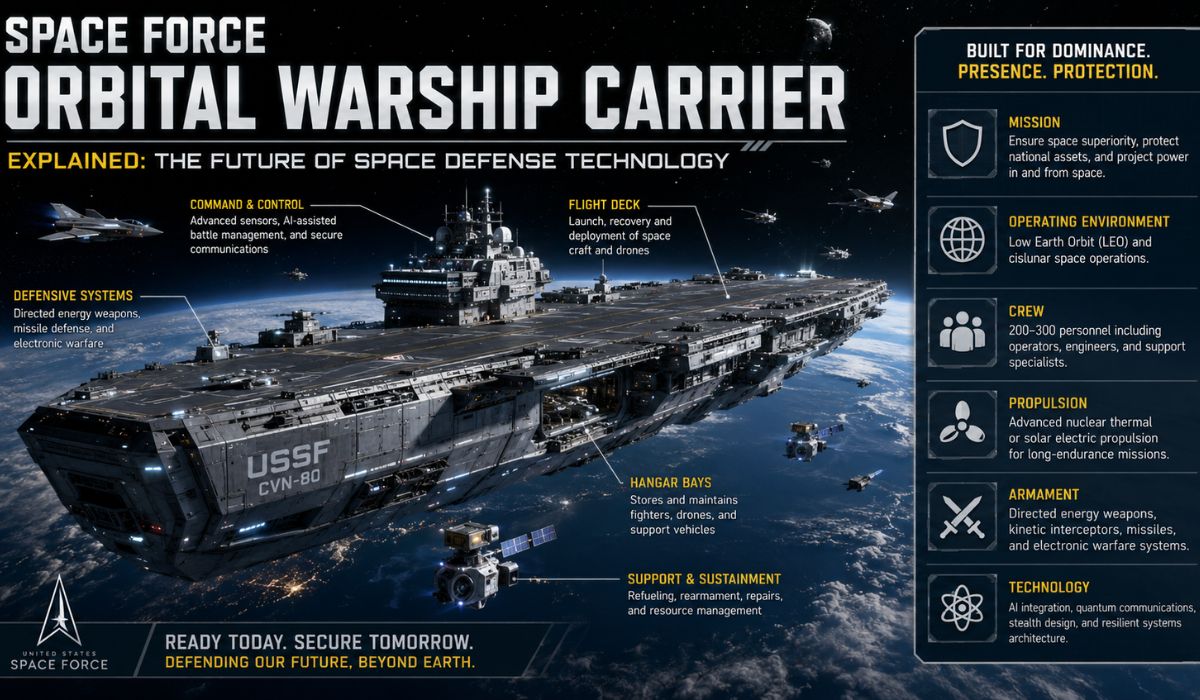
The idea of a Space Force Orbital Warship Carrier represents one of the most ambitious visions in modern defense thinking. As global dependence on satellites continues to grow, space is no longer just a scientific frontier but also a critical security domain. Communication networks, GPS systems, weather forecasting, financial systems, and military operations all rely heavily on orbital infrastructure. This growing dependence has led experts to imagine advanced defense systems that could protect space assets from emerging threats. The Space Force Orbital Warship Carrier is a conceptual solution that reflects how future space security might evolve. It combines command systems, orbital drones, satellite defense tools, and advanced communication networks into one powerful space-based platform designed to operate in Earth’s orbit.
1. Space Force Orbital Warship Carrier Concept Overview
The Space Force Orbital Warship Carrier is a theoretical military platform designed to function as a mobile base in space. It is inspired by naval aircraft carriers but adapted for orbital operations. Instead of aircraft, it would deploy satellites, drones, and robotic systems. Its main role would be to manage, protect, and coordinate space-based assets. While it does not exist today, the concept reflects how military planners are thinking about future orbital security and the increasing importance of controlling space infrastructure.
2. Rising Importance Of Space Defense Systems
Modern society depends heavily on satellite technology for everyday life. Banking systems, transportation networks, emergency services, and global communication all rely on stable orbital systems. Because of this dependency, any disruption in space could have serious global consequences. The Space Force Orbital Warship Carrier concept emerges from the need to secure these systems. As nations expand their space capabilities, protecting orbital assets becomes as important as defending land, sea, or air territories.
3. Strategic Purpose Of An Orbital Warship Carrier
The strategic purpose of a Space Force Orbital Warship Carrier is to serve as a centralized command hub in orbit. It would monitor satellite activity, detect potential threats, and coordinate defensive responses. It could also function as a rapid-response system in case of satellite malfunction or collision risks. In theory, such a system would strengthen space stability and reduce the time required to respond to emergencies in orbit.
4. Operational Mechanism In Space Environment
If developed, the Space Force Orbital Warship Carrier would operate in Earth’s orbit using advanced propulsion and navigation systems. It would maintain a stable orbital path while continuously communicating with satellites and ground stations. Autonomous systems would assist in monitoring orbital traffic, while human operators would oversee critical decisions. Its operational structure would depend heavily on artificial intelligence and real-time data processing to manage complex space environments.
5. Structural Design And Engineering Requirements
The design of a Space Force Orbital Warship Carrier would require modular construction to support long-term missions in space. It would need radiation shielding to protect onboard systems from solar exposure. The structure would likely include docking bays for spacecraft, storage compartments for equipment, and external arms for robotic operations. Advanced materials would be essential to withstand extreme temperature changes and micro-meteoroid impacts in space.
6. Power Systems And Energy Management
Energy is one of the most critical challenges in orbital operations. A Space Force Orbital Warship Carrier would likely rely on a combination of solar power systems and advanced nuclear energy sources. Solar panels could provide continuous energy during orbital exposure, while nuclear systems could support high-demand operations. Efficient energy storage and distribution systems would be necessary to maintain long-term functionality in deep space conditions.
7. Command Center And Artificial Intelligence Role
At the core of the Space Force Orbital Warship Carrier would be a highly advanced command center. This system would use artificial intelligence to analyze orbital data, detect anomalies, and assist in decision-making. AI would help track thousands of satellites simultaneously and identify unusual behavior patterns. However, human operators would still play a key role in strategic decisions, ensuring that critical actions remain under human control.
8. Orbital Drone Systems And Support Craft
A major feature of the Space Force Orbital Warship Carrier would be its ability to deploy smaller spacecraft. These could include inspection drones, repair robots, surveillance satellites, and defensive interceptors. These support craft would extend the carrier’s reach across orbit, allowing it to perform maintenance tasks, monitor threats, and support damaged satellites. This multi-layered system would make orbital operations more flexible and responsive.
9. Defensive Capabilities And Security Systems
Defense in space is different from traditional warfare due to the extreme speed and sensitivity of orbital objects. The Space Force Orbital Warship Carrier would likely use electronic warfare tools, anti-jamming systems, and advanced tracking technologies. Some theoretical concepts include directed energy systems and kinetic interceptors. However, the primary focus would likely be deterrence and protection rather than direct confrontation, as space debris poses a serious risk.
10. Satellite Protection And Global Dependence
Satellites play a vital role in modern civilization. They support navigation systems, communication networks, climate monitoring, and defense operations. The Space Force Orbital Warship Carrier would serve as a protective shield for these assets. It could detect threats early, coordinate repairs, and deploy backup systems when needed. This would significantly improve the resilience of global satellite networks and reduce the risk of large-scale disruptions.
11. Role In Space Warfare Strategy
Space warfare strategy is based on surveillance, deterrence, and control of orbital assets. The Space Force Orbital Warship Carrier would function as both a defensive and strategic platform. It would monitor missile launches, track space objects, and support secure communication networks. Its presence in orbit could act as a deterrent against hostile actions targeting satellites or space infrastructure.
12. Engineering And Technological Challenges
Building a Space Force Orbital Warship Carrier would require major technological advancements. Current limitations include high launch costs, limited propulsion efficiency, and difficulties in constructing large structures in orbit. Long-term maintenance and repair in space also present significant challenges. Additionally, cybersecurity risks must be addressed to prevent unauthorized control of space-based systems.
13. Legal And International Space Regulations
Space is governed by international treaties that restrict the placement of certain weapons in orbit. The development of a Space Force Orbital Warship Carrier would raise legal and diplomatic questions. While defensive systems may be acceptable, weaponization of space could lead to international tension. Cooperation between nations would be necessary to ensure space remains a stable and peaceful environment.
14. Future Developments And Real-World Progress
Although the Space Force Orbital Warship Carrier is currently a concept, real-world developments are moving in a similar direction. Space agencies and private companies are developing satellite servicing technologies, reusable rockets, and orbital stations. These innovations could eventually form the foundation for more advanced orbital defense systems. Early versions may focus on repair missions and satellite logistics before evolving into more complex platforms.
15. Long-Term Vision Of Orbital Defense Systems
In the long term, orbital defense systems may become a standard part of global security infrastructure. The Space Force Orbital Warship Carrier represents a vision of how humanity might protect its growing presence in space. As exploration expands toward the Moon and Mars, maintaining secure communication and navigation systems will become even more important. This concept reflects a future where space is both a frontier of opportunity and a domain requiring advanced protection.
Final Thoughts
The Space Force Orbital Warship Carrier represents a forward-looking idea shaped by the rapid evolution of space technology and global dependence on satellites. While it remains a conceptual model today, it highlights how important orbital security may become in the future. As humanity continues to expand beyond Earth, systems like this could play a role in protecting infrastructure, supporting exploration, and maintaining stability in space. Whether or not a full-scale version is ever built, the concept itself helps us understand the direction of future space defense and the increasing value of orbital technology.
FAQs About Space Force Orbital Warship Carrier
What Is A Space Force Orbital Warship Carrier
A Space Force Orbital Warship Carrier Is A Conceptual Space-Based Platform Designed To Support Satellite Protection And Orbital Defense Operations. It Would Function As A Command Center And Support Hub In Space.
Is The Space Force Orbital Warship Carrier Real Today
No, It Does Not Exist In Reality. It Is A Futuristic Concept Based On Emerging Space Defense Technologies And The Growing Importance Of Satellite Security.
Why Is The Space Force Orbital Warship Carrier Important
It Is Important In Theory Because Modern Society Relies Heavily On Satellites For Communication, Navigation, And Security. Protecting These Systems Is Becoming A Global Priority.
How Would A Space Force Orbital Warship Carrier Work
It Would Operate In Orbit Using Artificial Intelligence, Drones, And Advanced Communication Systems To Monitor And Protect Satellites And Coordinate Space Activities.
Could It Start A Space Conflict
If Used Aggressively, It Could Increase International Tensions. However, If Used For Defense And Protection, It Could Help Prevent Conflicts And Improve Space Stability.
What Technologies Are Needed For This Concept
It Would Require Advanced Propulsion Systems, Artificial Intelligence, Robotics, Radiation Protection, Cybersecurity Systems, And High-Efficiency Energy Sources.
Will This Technology Exist In The Future
Parts Of The Concept May Become Real Over Time As Space Technology Advances, Especially In Satellite Defense, Orbital Repair Systems, And Space Logistics Platforms.
Recommended For You: What Is CYOC? Understanding Its Meaning And Uses Across Different Industries