
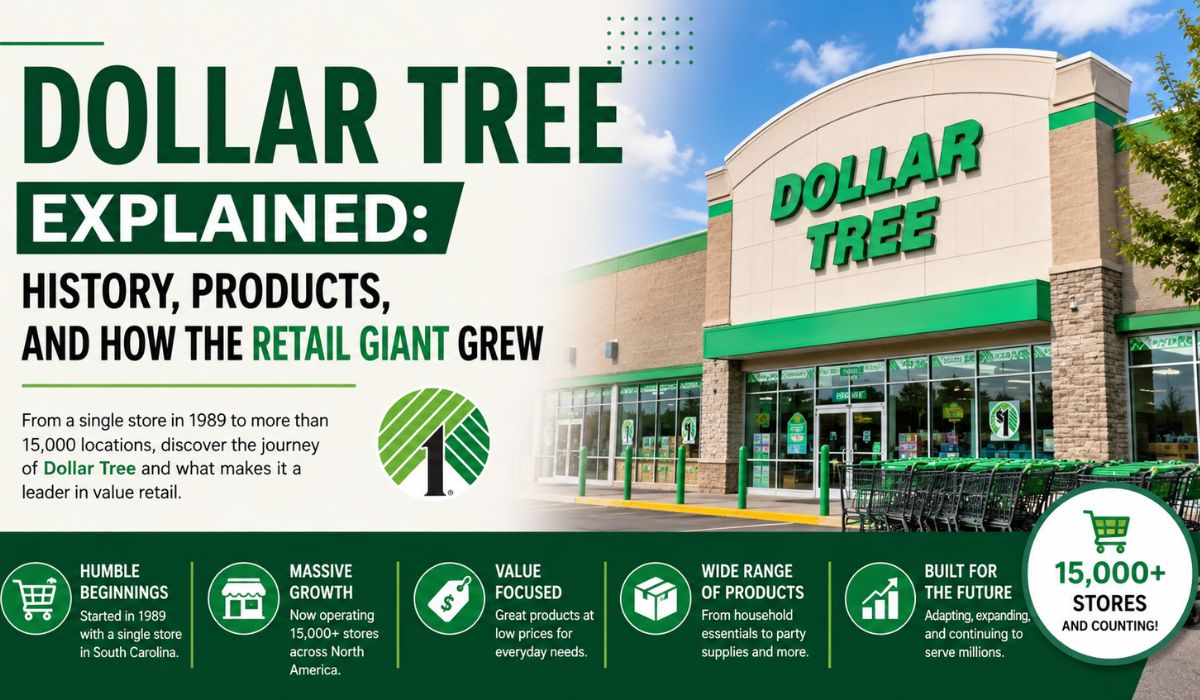
Dollar Tree is one of the most recognizable names in discount retail. For decades, shoppers have visited Dollar Tree stores to find affordable household essentials, party supplies, snacks, seasonal decorations, and everyday necessities. What started as a small discount store concept eventually grew into one of the largest value-focused retail chains in North America.
Today, Dollar Tree operates thousands of locations across the United States and Canada, serving millions of customers every year. The company has become known for helping shoppers stretch their budgets while offering a surprisingly broad selection of products. Over time, Dollar Tree has evolved from a strict one-dollar retailer into a modern discount chain with multiple price points, new store formats, and a continually expanding product assortment.
Understanding the story behind Dollar Tree provides valuable insight into the growth of the discount retail industry itself. From its humble beginnings to major acquisitions and strategic changes, Dollar Tree’s journey reflects changing consumer habits, economic conditions, and retail trends. This guide explores the company’s history, products, business strategy, expansion efforts, and the factors that helped it become a retail giant.
Quick Bio Information
| Information | Details |
|---|---|
| Company Name | Dollar Tree, Inc. |
| Industry | Discount Retail |
| Headquarters | Chesapeake, Virginia, United States |
| Founded | 1986 |
| First Dollar Tree Store | 1989 |
| Founders | Doug Perry, Macon Brock, Ray Compton |
| Original Name | Only $1.00 |
| Public Company | Yes |
| Fortune Ranking | Fortune 500 Company |
| Store Count | More Than 15,000 Locations |
| Countries Served | United States And Canada |
| Distribution Centers | 24+ Distribution Facilities |
| Main Retail Segment | Discount Variety Stores |
| Major Acquisition | Family Dollar |
| Canadian Expansion | Through Dollar Giant Acquisition |
| Current Pricing Model | Multi-Price Retail Strategy |
| Popular Products | Food, Party Supplies, Household Goods |
| Target Customers | Value-Conscious Shoppers |
| Employees | More Than 200,000 Across Operations |
| Current CEO | Michael C. Creedon Jr. |
What Is Dollar Tree?
Dollar Tree is an American discount retail chain that specializes in offering a wide variety of products at affordable prices. Unlike traditional department stores or supermarkets, Dollar Tree focuses on value-driven shopping. Customers can find thousands of products across numerous categories while spending significantly less than they might at larger retail chains.
The company serves a diverse customer base. Families looking to reduce grocery expenses, teachers purchasing classroom supplies, party planners searching for decorations, and individuals seeking everyday household products often turn to Dollar Tree. The company’s emphasis on affordability has helped it remain relevant during both strong and challenging economic periods.
Dollar Tree stores are designed to provide convenience and simplicity. Most locations are easy to navigate, allowing customers to quickly find products ranging from snacks and beverages to cleaning supplies and seasonal merchandise.
The Origins Of Dollar Tree
The history of Dollar Tree begins long before the company adopted its current name. In 1953, K.R. Perry opened a Ben Franklin variety store in Norfolk, Virginia. This early retail experience laid the foundation for what would eventually become a major discount retail enterprise.
During the 1970s, K.R. Perry joined forces with Doug Perry and Macon Brock to create K&K Toys. The toy chain expanded successfully throughout the eastern United States, giving the founders valuable experience in retail operations, merchandising, and customer service.
In 1986, Doug Perry, Macon Brock, and Ray Compton launched a new concept called Only $1.00. The idea was simple but powerful: offer products at a fixed low price that shoppers could easily understand and trust. The concept gained traction quickly because customers appreciated the predictable pricing and value-focused approach.
From Only $1.00 To Dollar Tree
As the business expanded, company leaders recognized that the brand would eventually need greater flexibility. In 1993, the company officially changed its name from Only $1.00 to Dollar Tree Stores.
The new name allowed the retailer to maintain its value-focused identity while creating opportunities for future growth. The rebranding also helped establish a stronger national presence as the company expanded beyond its original markets.
The first Dollar Tree-branded store had opened in Sumter, South Carolina, in 1989. By the early 1990s, the company was already gaining recognition as one of the most promising discount retail concepts in the country.
The decision to focus entirely on dollar stores proved highly successful. After selling its toy store operations, company leadership concentrated resources on expanding Dollar Tree locations throughout the United States.
The Growth Of Dollar Tree Across America
Throughout the 1990s and early 2000s, Dollar Tree experienced rapid expansion. New stores opened regularly, while the company invested heavily in distribution centers and logistics infrastructure.
One of the most important aspects of Dollar Tree’s growth strategy was its ability to build a strong supply chain network. Distribution centers were strategically located throughout the country, allowing stores to maintain inventory efficiently and keep costs under control.
By 2004, Dollar Tree had achieved a significant milestone by operating stores in all 48 contiguous states. This nationwide presence helped strengthen brand recognition and provided economies of scale that supported continued growth.
As store counts increased, Dollar Tree became a familiar shopping destination in urban areas, suburban communities, and smaller towns alike.
How Dollar Tree Became A Fortune 500 Company
Dollar Tree’s growth was not limited to store expansion. Revenue increased steadily as more customers embraced discount shopping. The company’s efficient business model allowed it to generate strong sales while maintaining competitive pricing.
In 2008, Dollar Tree earned a place on the Fortune 500 list. This achievement reflected decades of strategic planning, disciplined expansion, and operational efficiency.
Several factors contributed to this success. The company consistently focused on customer value, maintained careful control over expenses, and adapted to changing market conditions. Unlike some retailers that struggled during economic downturns, Dollar Tree often benefited from increased consumer demand for affordable products.
Its ability to attract both budget-conscious shoppers and middle-income consumers helped create a broad customer base that supported long-term growth.
Dollar Tree’s Business Model
Dollar Tree operates as what industry experts often describe as an extreme discount retailer. The company seeks to provide products at prices that appeal to cost-conscious shoppers while maintaining profitability through efficient operations.
A major component of the business model involves purchasing products in large quantities. By leveraging its buying power, Dollar Tree negotiates favorable pricing from suppliers and manufacturers. These savings are then passed on to customers through lower retail prices.
The company also relies heavily on private-label products alongside nationally recognized brands. This approach allows Dollar Tree to offer attractive price points while maintaining healthy profit margins.
Efficient inventory management plays a critical role as well. Products move quickly through stores, helping reduce storage costs and improve overall operational performance.
What Products Does Dollar Tree Sell?
One reason for Dollar Tree’s popularity is the wide variety of merchandise available in its stores. Customers can often complete multiple shopping tasks during a single visit.
Food and snack items remain among the most popular categories. Many stores carry canned goods, packaged snacks, beverages, frozen foods, and refrigerated products. While selections vary by location, food products represent an increasingly important part of the company’s business.
Health and beauty items are also common. Customers can find personal care products, cosmetics, hygiene supplies, and basic healthcare items at affordable prices.
Household products represent another major category. Cleaning supplies, kitchen tools, storage containers, laundry products, and home organization items are widely available. Seasonal merchandise adds further variety throughout the year, with holiday decorations, gifts, and themed products drawing significant customer interest.
Why Customers Love Dollar Tree
The appeal of Dollar Tree extends beyond low prices. Many shoppers enjoy the sense of discovery that comes with visiting the store. New merchandise arrives frequently, creating opportunities to find unexpected bargains and seasonal deals.
Convenience also plays an important role. With thousands of locations across North America, many customers have a Dollar Tree store close to home. Quick shopping trips for everyday essentials are often easier than visiting larger retail centers.
For families, teachers, nonprofit organizations, and small businesses, Dollar Tree provides access to affordable products that help stretch limited budgets. This practical value has contributed significantly to the company’s loyal customer base.
The combination of affordability, variety, and convenience continues to make Dollar Tree a popular destination for millions of shoppers each year.
How Dollar Tree’s Pricing Strategy Changed
For many years, Dollar Tree was known for a simple promise: nearly every item in the store cost exactly one dollar. This fixed-price model became one of the company’s strongest marketing advantages because customers always knew what to expect when they entered a store.
However, the retail environment changed significantly during the late 2010s and early 2020s. Rising transportation costs, supply chain challenges, labor expenses, and inflation placed pressure on retailers across the country. To maintain profitability while continuing to offer value, Dollar Tree gradually adjusted its pricing strategy.
The most noticeable change came when many products increased from $1.00 to $1.25. Although some shoppers initially reacted with surprise, the company argued that the change would allow it to continue offering quality products while expanding product selection. Since then, Dollar Tree has introduced additional price points, creating a more flexible retail model while preserving its value-oriented identity.
Dollar Tree Plus And The New Shopping Experience
As consumer preferences evolved, Dollar Tree introduced Dollar Tree Plus. This concept added merchandise priced above the traditional dollar range, often featuring products at $3 and $5.
The goal was to provide customers with access to larger, higher-quality, or more specialized products while maintaining affordability. Shoppers could find expanded selections of home décor, seasonal merchandise, toys, storage solutions, and household goods.
The success of Dollar Tree Plus encouraged the company to continue experimenting with multi-price merchandising. New formats eventually expanded pricing up to approximately $7 in many locations. These additions allowed Dollar Tree to compete more effectively with other discount retailers while giving customers more choices within a single store.
Rather than abandoning its value-focused roots, the company adapted to changing economic realities and customer expectations.
Major Acquisitions That Fueled Growth
Acquisitions have played a major role in Dollar Tree’s expansion strategy. Throughout its history, the company has purchased several regional discount chains, allowing it to grow more quickly than it could through new store openings alone.
During the 1990s and early 2000s, Dollar Tree acquired companies such as Dollar Bill$, Dollar Express, Greenbacks, and Only $One. These acquisitions helped the retailer enter new markets, gain experienced employees, and strengthen its customer base.
Each acquisition added scale and operational advantages. The company’s growing distribution network supported these expansions, helping maintain efficient inventory management across thousands of stores.
This combination of organic growth and strategic acquisitions became one of the key factors behind Dollar Tree’s rise within the highly competitive discount retail industry.
The Family Dollar Acquisition
One of the most significant events in Dollar Tree’s history was its acquisition of Family Dollar. The deal was announced in 2014 and completed in 2015 after receiving regulatory approval.
The acquisition dramatically increased Dollar Tree’s retail footprint. Family Dollar already operated thousands of stores throughout the United States, serving many communities that differed from Dollar Tree’s traditional customer base.
By combining the two businesses, Dollar Tree gained access to new markets and customer segments. The acquisition also strengthened the company’s position within the discount retail industry, making it a more formidable competitor against rivals.
Managing two major retail brands presented challenges, however. Over time, company leadership worked to improve operations, optimize store performance, and create efficiencies across both chains.
The Sale Of Family Dollar
While the Family Dollar acquisition initially appeared to be a transformational opportunity, the chain faced ongoing operational challenges. Market competition increased, consumer preferences shifted, and some locations struggled to meet performance expectations.
After years of evaluating strategic options, Dollar Tree announced plans to sell Family Dollar in 2025. The sale marked the end of a significant chapter in the company’s history.
Industry analysts viewed the decision as part of a broader effort to simplify operations and allow Dollar Tree to focus more directly on its core brand. By reducing complexity, the company positioned itself to invest resources into store improvements, merchandising innovation, and future growth opportunities.
The move highlighted management’s willingness to adapt strategy when market conditions changed.
Dollar Tree’s Expansion Into Canada
Dollar Tree’s international presence began through its acquisition of Dollar Giant in 2010. This transaction gave the company an established foothold in Canada and represented its first major expansion beyond the United States.
Following the acquisition, Dollar Giant locations were gradually rebranded as Dollar Tree stores. Today, Dollar Tree Canada operates hundreds of locations across several provinces.
Canadian stores follow a similar value-focused approach but often use different pricing structures due to local market conditions, currency differences, and operating costs. Customers can find many of the same product categories available in American stores, including household supplies, seasonal items, snacks, party products, and personal care goods.
The Canadian division remains an important component of the company’s long-term growth strategy.
The Importance Of Distribution And Logistics
Behind every successful Dollar Tree store is a sophisticated logistics network. The company operates numerous distribution centers strategically located throughout North America.
These facilities receive merchandise from manufacturers and suppliers before shipping products to individual stores. Efficient logistics help keep shelves stocked while minimizing transportation expenses.
The distribution network provides several advantages. It supports rapid inventory replenishment, improves product availability, and helps control operating costs. These efficiencies allow Dollar Tree to maintain competitive pricing while serving thousands of locations.
In many ways, the company’s logistics infrastructure is just as important to its success as the products sold inside its stores.
Challenges And Criticism
Like many large retailers, Dollar Tree has faced criticism and challenges throughout its history. One frequently discussed topic involves concerns about food deserts in certain communities.
Some researchers and community advocates argue that dollar stores may contribute to reduced access to traditional grocery stores. Critics suggest that discount retailers can sometimes compete with smaller food retailers, potentially limiting options for fresh produce and other healthy foods.
Dollar Tree has disputed these claims, arguing that its stores often bring affordable food products into areas where limited shopping options already exist. The company maintains that it helps improve access to basic necessities for many underserved communities.
The debate continues among policymakers, researchers, and community leaders, reflecting broader discussions about retail development and food accessibility.
Economic Pressures And Store Closures
The retail industry has experienced significant challenges during recent years. Inflation, labor shortages, transportation costs, and changing shopping habits have affected businesses across the sector.
Dollar Tree has responded by evaluating store performance and making adjustments where necessary. Some underperforming locations have closed, while other stores have undergone renovations and modernization efforts.
Store optimization strategies are common among major retailers. These efforts help companies allocate resources more effectively while improving customer experiences at stronger-performing locations.
Despite occasional closures, Dollar Tree continues to maintain one of the largest retail footprints in North America.
Leadership And Recent Developments
Strong leadership has played an important role in Dollar Tree’s growth. In recent years, management has focused on adapting to changing market conditions while pursuing long-term profitability.
Michael C. Creedon Jr. became the company’s permanent Chief Executive Officer after previously serving in senior leadership roles. His appointment reflected the board’s confidence in his ability to guide the company through a period of transformation.
Recent initiatives have included store improvements, merchandising enhancements, expanded product assortments, and continued investment in operational efficiency. These efforts aim to strengthen Dollar Tree’s position within the discount retail market while improving customer satisfaction.
As of 2026, the company remains focused on balancing value, growth, and operational discipline.
The Future Of Dollar Tree
Looking ahead, Dollar Tree appears well positioned to remain a major force in discount retail. Consumers continue seeking affordable shopping options, especially during periods of economic uncertainty.
The company’s future growth will likely depend on several factors, including effective merchandising, supply chain efficiency, store modernization, and the ability to respond quickly to consumer trends. Continued expansion of multi-price merchandise may also create new revenue opportunities.
Technology could play a larger role as well. Enhanced inventory systems, improved e-commerce capabilities, and data-driven decision-making may help the company operate more efficiently in the years ahead.
While retail markets continue to evolve, Dollar Tree’s commitment to value remains a core strength that resonates with millions of shoppers.
Why Dollar Tree Remains Relevant In 2026
The retail landscape has changed dramatically over the past several decades, yet Dollar Tree continues to attract customers across different income levels and demographics. Its success comes from understanding a simple but powerful principle: consumers appreciate value.
Whether shoppers are purchasing party supplies, seasonal decorations, snacks, cleaning products, or household essentials, they often find products that fit their budgets. This combination of affordability, convenience, and variety has helped Dollar Tree remain competitive even as consumer habits evolve.
The company’s willingness to adapt its pricing model, invest in infrastructure, and adjust its strategy demonstrates an ability to evolve without losing sight of its core mission.
Conclusion
Dollar Tree’s journey from a small discount store concept to a Fortune 500 retail giant is a remarkable example of long-term business growth. What began as a simple idea centered on affordable shopping evolved into a vast retail network serving millions of customers across North America.
Through strategic acquisitions, disciplined expansion, strong logistics, and a commitment to value, Dollar Tree built one of the most recognizable brands in discount retail. The company has adapted to changing economic conditions, modernized its pricing strategy, and continued investing in its future while staying focused on affordability.
As the retail industry continues to evolve, Dollar Tree remains an important destination for shoppers seeking convenience, variety, and value. Its history demonstrates how a clear mission, consistent execution, and willingness to adapt can transform a small retail concept into an industry leader.
FAQs About Dollar Tree
Is Dollar Tree Still A One-Dollar Store?
Dollar Tree is no longer strictly a one-dollar retailer. While the company built its reputation on fixed-price merchandise, most stores now offer products at multiple price points. Many items remain highly affordable, but customers can also find merchandise priced above the traditional one-dollar level.
Who Owns Dollar Tree?
Dollar Tree is a publicly traded company owned by its shareholders. Institutional investors, mutual funds, and individual investors collectively own shares of the business. The company is managed by its executive leadership team and board of directors.
How Many Dollar Tree Stores Are There?
Dollar Tree operates more than 15,000 stores across the United States and Canada. The exact number changes as new stores open and some locations close or relocate.
What Products Are Most Popular At Dollar Tree?
Popular categories include food and snacks, household cleaning supplies, party decorations, seasonal merchandise, health and beauty products, storage solutions, school supplies, and gift items. Product popularity often varies by location and season.
Does Dollar Tree Operate Outside The United States?
Yes. Dollar Tree operates hundreds of stores in Canada. The company’s Canadian presence began through its acquisition of Dollar Giant and continues to be an important part of its business operations.
Why Did Dollar Tree Raise Prices?
The company raised prices primarily due to rising costs associated with transportation, labor, manufacturing, and inflation. The pricing changes also allowed Dollar Tree to expand product selection and improve merchandise quality.
What Happened To Family Dollar?
Dollar Tree acquired Family Dollar in 2015 as part of a major expansion strategy. In 2025, the company sold Family Dollar after determining that focusing on its core Dollar Tree operations would better support long-term growth.
Is Dollar Tree Growing Or Shrinking?
Dollar Tree continues to be a major retailer with ongoing investments in store improvements, merchandising, and operational efficiency. While some locations have closed as part of optimization efforts, the company remains one of the largest discount retail chains in North America.
Recommended For You: clima de hoy: Updated And Detailed Weather Forecast In Your Region