
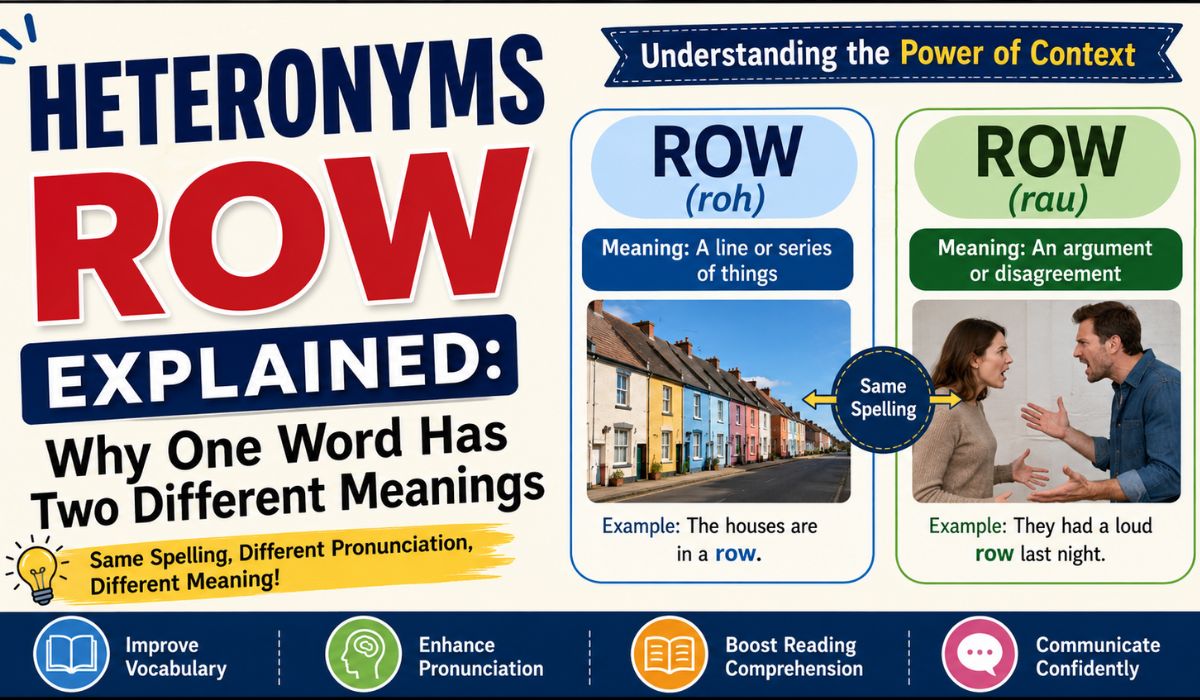
wn examples is the word row. This simple four-letter word can describe a straight line of objects or a heated argument, depending on how it is pronounced. Because of this unique characteristic, many people search for information about Heteronyms Row to better understand why the same word can mean completely different things.
Learning about Heteronyms Row is useful for students, writers, teachers, language learners, and anyone interested in improving their English skills. Understanding how heteronyms work can strengthen reading comprehension, improve pronunciation, and help readers interpret sentences more accurately. While the word may look simple on paper, its meaning changes dramatically based on context. This article explores the meaning of Heteronyms Row, explains why it causes confusion, examines its role in the English language, and provides practical insights that make these unusual words easier to understand.
What Is A Heteronym?
A heteronym is a word that has the same spelling as another word but differs in pronunciation and meaning. Unlike many other vocabulary patterns in English, heteronyms require readers to rely on context rather than spelling alone. The spelling stays the same, but the sound and definition change depending on how the word is being used.
For example, the word lead can refer to guiding someone, which is pronounced “leed,” or it can refer to the metal, pronounced “led.” The same spelling represents two entirely different concepts. This characteristic makes heteronyms both fascinating and challenging. They force readers to pay close attention to the surrounding words in a sentence before deciding how to pronounce a term correctly.
Heteronyms are considered a special type of homograph because they share spelling while differing in pronunciation. They appear throughout modern English and often create confusion for language learners who expect words with identical spelling to sound the same.
Understanding Heteronyms Row
The phrase Heteronyms Row refers to the word row, which perfectly demonstrates how heteronyms work. The spelling remains unchanged, but the pronunciation varies according to meaning.
When pronounced as “roh” (/roʊ/), the word describes a line or arrangement of objects. A person may sit in a row of seats at a stadium or walk past a row of houses on a street. In this case, the word represents order and arrangement.
When pronounced as “rau” (/raʊ/), the word refers to an argument, disagreement, or quarrel. Newspapers in the United Kingdom frequently use this meaning when reporting political disputes or public disagreements. A headline might mention a row between government officials or a row involving a public policy issue.
Although both words look identical, they communicate entirely different ideas. This dual identity is what makes Row one of the most famous heteronyms in English.
Why The Word “Row” Causes Confusion
The main reason Row creates confusion is that readers cannot determine its meaning from spelling alone. Unlike most words, which maintain a single pronunciation regardless of context, Row requires additional information before it can be spoken correctly.
Imagine seeing the word by itself on a page. Without context, there is no way to know whether it refers to a line of objects or an argument. Only the surrounding sentence reveals the intended meaning.
Consider these examples:
They planted flowers in a row.
The neighbors had a loud row last night.
The first sentence clearly describes arrangement and order. The second sentence refers to a disagreement. Because the context differs, the pronunciation changes as well. This requirement to interpret meaning before pronunciation is what makes heteronyms challenging for many readers.
How Context Determines Pronunciation
Context is the most important tool for understanding Heteronyms Row. Skilled readers naturally use surrounding words to identify meaning before deciding how to pronounce a term.
When Row appears near words related to positions, organization, seating, housing, or planting, it usually means a line of objects. On the other hand, when it appears alongside words connected to conflict, disagreement, politics, or emotions, it often refers to an argument.
This process happens almost instantly for experienced readers. However, language learners may need practice to recognize these patterns. Over time, exposure to complete sentences helps readers become comfortable identifying heteronyms automatically.
Understanding context does more than improve pronunciation. It also enhances reading comprehension because readers learn to focus on the overall meaning of a sentence rather than individual words alone.
The Difference Between Heteronyms, Homographs, Homophones, And Homonyms
Many people confuse heteronyms with several related language concepts. While they share similarities, each category has a distinct definition.
Homographs are words that share the same spelling. Some homographs are pronounced differently, while others are not. Heteronyms belong to this category because they have identical spelling.
Homophones are words that sound alike but have different meanings. Examples include sea and see. Their spelling differs, but their pronunciation remains the same.
Homonyms serve as a broader category that includes words sharing either spelling, pronunciation, or both.
Understanding these distinctions helps readers classify words more accurately. Heteronyms stand out because they combine identical spelling with different pronunciation and meaning.
Common Heteronym Examples Beyond Row
Although Row is one of the most famous examples, many heteronyms appear regularly in daily communication.
The word wind may describe moving air or the action of twisting something. The word tear may refer to ripping paper or a drop of liquid from the eye. Bass can describe a type of fish or a low musical tone. Present may mean current or refer to the act of giving something.
Another common example is record. As a noun, it refers to stored information. As a verb, it means to capture audio or video. The pronunciation shifts based on meaning, making it another classic heteronym.
These examples demonstrate that Heteronyms Row is part of a much larger pattern found throughout English vocabulary.
Why English Has So Many Heteronyms
The English language developed through centuries of interaction among different cultures and languages. Influences from Old English, Latin, French, Greek, Norse languages, and Germanic dialects created a rich but often complex vocabulary system.
As English evolved, many words retained historical spellings even as pronunciation changed. Over time, identical spellings acquired different meanings and sounds. The result was the creation of numerous heteronyms.
This historical development explains why English pronunciation sometimes appears inconsistent. While modern spelling preserves traces of the language’s past, pronunciation reflects centuries of change. Heteronyms are one of the clearest examples of this linguistic evolution.
How Heteronyms Affect Reading And Pronunciation Skills
Heteronyms play a major role in reading fluency. Readers who understand them can process text more accurately and confidently. Those who misinterpret them may misunderstand entire sentences.
For example, if a reader mistakenly interprets record as a noun when it is being used as a verb, the meaning of the sentence changes significantly. Similar problems occur with Row. Mispronouncing the word can create confusion and reduce comprehension.
Teachers often use heteronyms in language-learning exercises because they encourage students to analyze context carefully. Rather than relying only on spelling, learners develop deeper reading skills that improve overall language understanding.
Heteronyms In Everyday Communication
Many people use heteronyms every day without realizing it. Newspapers, books, websites, television programs, podcasts, and social media posts frequently contain words whose pronunciation depends on context. Native speakers usually interpret these words automatically because they have encountered them countless times throughout their lives.
For English learners, however, heteronyms can feel confusing at first. The challenge comes from the fact that pronunciation cannot always be determined by spelling alone. A reader must understand the meaning of the sentence before deciding how to pronounce the word. This process becomes easier with practice and exposure. Over time, learners begin to recognize patterns and interpret heteronyms naturally, just as native speakers do.
The word Row is particularly common in journalism. British newspapers often use it to describe political disagreements, legal disputes, or public controversies. At the same time, the same word regularly appears in descriptions of seating arrangements, streets, gardens, and buildings. This frequent use makes Row one of the most practical heteronyms to study.
Heteronyms In Literature, Education, And Technology
Writers have long used heteronyms to create interesting effects in literature. Because these words carry multiple meanings, authors can use them to add depth, humor, or wordplay to their writing. Poetry, novels, and short stories often include heteronyms that encourage readers to think carefully about interpretation.
In education, heteronyms serve as valuable teaching tools. Teachers use them to strengthen vocabulary development, reading comprehension, and pronunciation skills. Students learn that language is not simply about recognizing letters on a page but also about understanding meaning and context.
Technology has introduced new challenges related to heteronyms. Speech-recognition software, text-to-speech systems, virtual assistants, and translation tools must analyze context before selecting the correct pronunciation. Consider the sentence:
“I Need To Record A Record.”
The first occurrence of Record functions as a verb, while the second functions as a noun. Advanced language-processing systems must identify these differences to produce accurate speech. This demonstrates that heteronyms remain relevant even in modern digital communication.
Stress Patterns And Pronunciation Changes
One fascinating feature of many heteronyms is the role of stress. In English, changing the stressed syllable often changes pronunciation and meaning.
For example, the noun Record is pronounced differently from the verb Record. The same pattern appears in Present, Conduct, Object, and several other heteronyms. These shifts are not random. They reflect long-standing pronunciation patterns that developed throughout the history of English.
Learning stress patterns can significantly improve pronunciation accuracy. Readers who understand these patterns often find it easier to identify heteronyms and interpret unfamiliar words correctly. Although Row does not involve stress changes because it contains only one syllable, it still demonstrates how pronunciation can transform meaning.
Why Context Is More Important Than Spelling
Many language learners focus heavily on spelling when reading English. While spelling is important, heteronyms reveal its limitations. A correctly spelled word may still be misunderstood if context is ignored.
For example, someone encountering the word Row in isolation cannot know whether it means a line of objects or an argument. Context acts as the bridge between spelling and meaning. The surrounding words provide clues that guide pronunciation and interpretation.
This principle extends beyond heteronyms. Skilled readers consistently use context to understand unfamiliar vocabulary, identify figurative language, and interpret complex ideas. Studying Heteronyms Row helps readers develop this broader reading skill.
Interesting Facts About The Word Row
The word Row has a rich linguistic history. Its meaning related to arrangement and order comes from older Germanic language roots. The meaning associated with arguments developed separately and became especially common in British English.
Interestingly, the “argument” pronunciation is heard far more frequently in the United Kingdom than in some other English-speaking regions. Readers who consume British news content often encounter headlines describing political rows, diplomatic rows, or public rows.
Another interesting fact is that many native speakers understand both meanings instantly despite the pronunciation difference. This ability demonstrates how effectively the human brain uses context when processing language.
Tips For Learning And Remembering Heteronyms
Mastering heteronyms requires practice, but the process becomes easier when learners focus on context and real-world usage. Reading complete sentences rather than isolated words is one of the most effective learning strategies. Full sentences provide clues that reveal pronunciation and meaning.
Listening to native speakers can also be extremely helpful. Audiobooks, podcasts, educational videos, and conversations expose learners to correct pronunciation in natural settings. Hearing heteronyms repeatedly helps build familiarity and confidence.
Reading aloud offers another powerful learning method. By speaking words in context, learners strengthen the connection between spelling, pronunciation, and meaning. Over time, this practice reduces hesitation and improves overall fluency.
Using dictionaries that include pronunciation guides can also support learning. Modern dictionaries often provide audio recordings that demonstrate how heteronyms sound in different contexts. Combining these resources with regular reading creates steady improvement.
Quick Quiz: Test Your Understanding
Consider the following sentences and identify the correct meaning of each heteronym.
In the sentence “The Wind Was Strong Today,” Wind refers to moving air. In the sentence “Please Wind The Clock,” the same spelling refers to twisting or turning something.
In the sentence “Do Not Tear The Paper,” Tear means to rip. In the sentence “A Tear Fell From Her Eye,” it refers to a drop of liquid produced when crying.
In the sentence “They Will Record The Interview,” Record functions as a verb. In the sentence “I Bought A Vintage Record,” it functions as a noun.
These examples highlight how context determines pronunciation and meaning. The more readers practice with such examples, the easier heteronyms become.
The Growing Importance Of Heteronyms In 2026
As global communication continues to expand, English remains one of the most widely used languages in education, business, and technology. Millions of people learn English as a second language each year, making pronunciation and comprehension increasingly important.
Digital communication has also increased exposure to written English. People regularly encounter articles, social media posts, educational materials, and online discussions that contain heteronyms. Understanding words such as Row helps readers navigate these texts more effectively.
Artificial intelligence, language-learning platforms, and speech technologies continue to improve their handling of heteronyms. Yet even advanced systems rely on the same principle humans use: context. This fact highlights the lasting importance of understanding how heteronyms work.
Final Thoughts
Heteronyms Row provides an excellent example of how fascinating and complex the English language can be. A single word can represent completely different ideas depending on pronunciation and context. When pronounced as “roh,” Row describes a line or arrangement. When pronounced as “rau,” it refers to a disagreement or argument. This simple difference transforms the meaning of an entire sentence.
Understanding Heteronyms Row goes far beyond learning one unusual word. It helps readers develop stronger pronunciation skills, better reading comprehension, and a deeper appreciation for the richness of English. By paying attention to context and practicing common heteronyms, learners can navigate these challenging words with confidence.
As English continues to evolve in 2026 and beyond, heteronyms remain an important part of communication, education, literature, and technology. Whether you are a student, teacher, writer, or language enthusiast, mastering heteronyms will make reading more enjoyable and communication more effective. The next time you encounter the word Row, you will know exactly why one spelling can carry two very different meanings.
FAQs About Heteronyms Row
What Is Heteronyms Row?
Heteronyms Row refers to the word Row as an example of a heteronym. The word has the same spelling but different pronunciations and meanings. One pronunciation refers to a line of objects, while the other refers to an argument or dispute.
Why Does The Word Row Have Two Different Meanings?
The two meanings developed through different historical paths in the English language. Although the spellings eventually became identical, the pronunciations and definitions remained separate.
How Do I Know Which Pronunciation Of Row To Use?
The surrounding context determines the correct pronunciation. If the sentence discusses arrangement or positioning, Row usually means a line. If it discusses conflict or disagreement, Row usually means an argument.
Is Row The Most Common Heteronym In English?
Row is one of the most recognizable heteronyms, but several others are equally common, including Lead, Wind, Tear, Present, Record, and Bass.
Are Heteronyms Difficult For English Learners?
Many learners initially find heteronyms challenging because pronunciation cannot always be determined from spelling alone. However, regular reading and listening practice make them much easier to understand.
What Is The Difference Between A Heteronym And A Homograph?
A homograph is any word that shares spelling with another word. A heteronym is a specific type of homograph that also has a different pronunciation and meaning.
Why Are Heteronyms Important In Reading?
Heteronyms help readers develop stronger comprehension skills because they encourage attention to context. Understanding them improves pronunciation, vocabulary, and overall fluency.
Do Native Speakers Struggle With Heteronyms?
Most native speakers interpret common heteronyms automatically because they have extensive experience with them. However, unfamiliar heteronyms can occasionally cause confusion even among fluent readers.
Recommended For You: Innøve Meaning Explained: A Simple Guide To Smart Innovation And Growth