
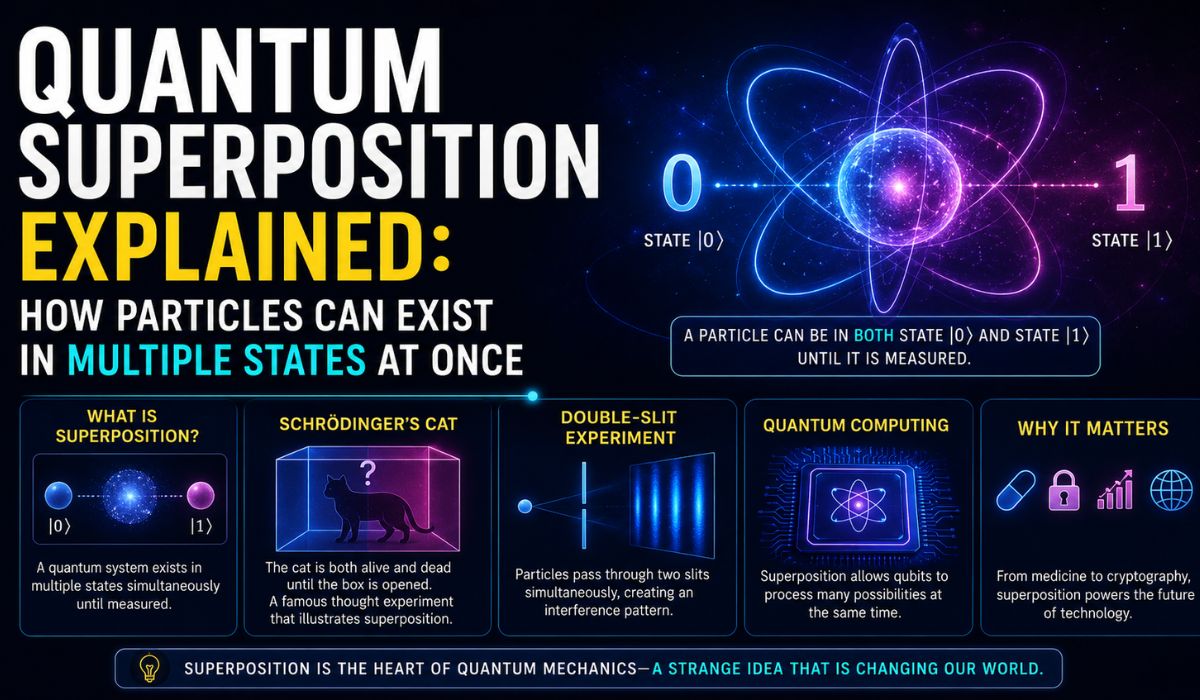
Quantum Superposition is one of the most fascinating ideas in modern science. It challenges the way we normally think about reality and introduces a world where particles can exist in more than one possible state at the same time. While this may sound like science fiction, Quantum Superposition is a well-established principle of Quantum Mechanics and has been confirmed through decades of scientific experiments.
Today, Quantum Superposition sits at the heart of Quantum Computing, Quantum Information Science, and many of the technologies researchers are developing for the future. Understanding this concept helps explain why Quantum Computers have attracted so much attention and why scientists believe they could eventually solve certain problems that are beyond the reach of classical computers.
Although the idea can seem strange at first, Quantum Superposition becomes much easier to understand when explored step by step. By examining Quantum States, Schrödinger’s Cat, the Double-Slit Experiment, and the role of Qubits in Quantum Computing, we can gain a clearer picture of how the Quantum World works and why it continues to reshape our understanding of nature.
Quick Bio Information
| Quantum Superposition Fact | Information |
|---|---|
| Scientific Field | Quantum Mechanics |
| Core Idea | Multiple States At Once |
| First Developed | Early 20th Century |
| Key Contributors | Schrödinger, Heisenberg, Dirac, Bohr |
| Mathematical Basis | Schrödinger’s Equation |
| Quantum Unit | Qubit |
| Classical Equivalent | Bit |
| State Representation | Wave Function |
| Probability Rule | Born Rule |
| Famous Thought Experiment | Schrödinger’s Cat |
| Famous Demonstration | Double-Slit Experiment |
| Related Concept | Quantum Entanglement |
| Computing Application | Quantum Computing |
| Major Challenge | Decoherence |
| Visualization Tool | Bloch Sphere |
| Information Scaling | Exponential State Space |
| Measurement Effect | Wave Function Collapse |
| Common Particles | Electrons And Photons |
What Is Quantum Superposition?
Quantum Superposition is the principle that a Quantum System can exist in multiple possible states simultaneously until it is measured. Unlike objects in our everyday world, which generally occupy one definite state at a time, Quantum Particles can exist in combinations of several states.
Imagine a traditional light switch. It is either on or off. A Quantum Particle behaves differently. Before measurement, it can exist in a combination of both possibilities. Only when an observation or measurement occurs does the system produce a specific outcome.
This does not mean the particle is secretly choosing one state while hiding the answer. Instead, Quantum Mechanics describes the particle as genuinely existing in a Superposition of possibilities. This idea forms one of the most important foundations of modern physics and explains many Quantum Phenomena that cannot be understood through Classical Physics alone.
Understanding Quantum States
To understand Quantum Superposition, it is helpful to first understand Quantum States. A Quantum State contains all the information scientists can know about a Quantum System. It describes the possible outcomes that could be observed when measurements are performed.
Unlike Classical Systems, where an object’s properties are fixed and definite, Quantum States allow multiple possibilities to coexist. These possibilities are represented mathematically by a Wave Function. The Wave Function does not tell us exactly what will happen. Instead, it provides probabilities for different outcomes.
This probabilistic nature is one of the reasons Quantum Mechanics feels unusual. Rather than predicting a single result with certainty, it predicts the likelihood of different outcomes. Quantum Superposition emerges naturally from this mathematical framework, allowing particles to occupy several possible states until observation occurs.
How Quantum Superposition Differs From Everyday Reality
Our daily experiences are shaped by Classical Physics. A football is located in one place. A coin lands as either heads or tails. A door is either open or closed. We do not encounter objects that appear to exist in multiple states simultaneously.
Quantum Particles behave differently because they exist at extremely small scales where Quantum Effects dominate. Electrons, Photons, and other subatomic particles follow rules that often seem counterintuitive from a human perspective.
One important reason we do not observe large objects in obvious Superposition States is a process known as Quantum Decoherence. Interactions with the surrounding environment rapidly destroy delicate Quantum States, causing objects to behave according to Classical Physics. This transition helps explain why the strange Quantum World remains hidden from everyday experience.
The Mathematics Behind Quantum Superposition
The scientific basis for Quantum Superposition comes from the mathematical framework of Quantum Mechanics, particularly Schrödinger’s Equation. One of the most important properties of this equation is its linearity.
In simple terms, if two Quantum States are valid solutions, they can be combined to create another valid Quantum State. This combination is known as a Superposition State. The mathematics allows multiple possibilities to coexist within a single Quantum System.
Scientists often use notation such as |0⟩ and |1⟩ to represent basic Quantum States. A Qubit, for example, can exist as a combination of both states simultaneously. This mathematical flexibility is what enables Quantum Computers to process information in fundamentally different ways than traditional computers.
Schrödinger’s Cat And The Meaning Of Superposition
Perhaps the most famous illustration of Quantum Superposition is Schrödinger’s Cat. Proposed by Austrian Physicist Erwin Schrödinger in 1935, the thought experiment was designed to highlight the strange implications of Quantum Theory.
In the scenario, a cat is placed inside a sealed box with a radioactive atom, a detector, and a poison mechanism. If the atom decays, the poison is released and the cat dies. If the atom does not decay, the cat remains alive.
According to a simplified interpretation of Quantum Mechanics, the atom exists in a Superposition of decayed and not decayed states before observation. Consequently, the cat appears to exist in a Superposition of alive and dead states. While the example was originally intended to challenge certain interpretations of Quantum Mechanics, it has become one of the most famous explanations of Quantum Superposition.
The Double-Slit Experiment
Few experiments demonstrate Quantum Superposition more clearly than the Double-Slit Experiment. In this experiment, particles such as electrons or photons are fired toward a barrier containing two narrow openings.
If the particles behaved like tiny classical objects, scientists would expect two distinct bands to appear on a screen behind the barrier. Instead, an interference pattern emerges, resembling the behavior of waves.
This surprising result suggests that each particle behaves as though it passes through both slits simultaneously while in a Superposition State. When detectors are placed near the slits to determine the particle’s path, the interference pattern disappears. The experiment remains one of the strongest pieces of evidence supporting Quantum Superposition and the unusual nature of Quantum Reality.
Quantum Probability And The Nature Of Measurement
One of the most important ideas connected to Quantum Superposition is Quantum Probability. In Classical Physics, probability is usually linked to uncertainty about information. For example, if a coin is hidden under a cup, it is already heads or tails; we simply do not know which one. Quantum Mechanics works differently. Before measurement, a Quantum Particle may genuinely exist in a combination of possible states rather than possessing a hidden definite value.
Scientists use a mathematical rule called the Born Rule to calculate the likelihood of different outcomes. The probability of observing a particular state is determined by the square of the amplitude associated with that state. When a measurement occurs, the Quantum State appears to collapse into one specific result. This process remains one of the most fascinating and debated aspects of Quantum Theory, and it highlights why Quantum Superposition is so different from ordinary uncertainty.
Quantum Interference And Why It Matters
Quantum Interference is the mechanism that makes Quantum Superposition useful. When a Quantum System exists in multiple states simultaneously, each state carries a probability amplitude. These amplitudes can combine with one another in ways that either strengthen or weaken possible outcomes.
Constructive Interference occurs when amplitudes reinforce each other, making certain outcomes more likely. Destructive Interference occurs when amplitudes cancel each other out, reducing the likelihood of other outcomes. This behavior is very different from Classical Probability and allows Quantum Systems to process information in unique ways.
Quantum Algorithms rely heavily on carefully controlled interference patterns. Rather than simply exploring many possibilities, Quantum Computers use interference to amplify correct answers and suppress incorrect ones. This ability is one of the key reasons Quantum Computing has become such an important area of research.
Superposition And Entanglement
Quantum Superposition and Quantum Entanglement are often mentioned together, but they describe different phenomena. Superposition refers to a single particle existing in multiple possible states at the same time. Entanglement involves two or more particles becoming linked so that their properties are connected, even when separated by large distances.
When particles become entangled, measuring one particle immediately affects the description of the other particle within the Quantum System. This does not allow faster-than-light communication, but it does reveal a deep connection between the particles.
In Quantum Computing, Superposition creates many possible computational states, while Entanglement allows those states to be correlated and manipulated together. The combination of these two Quantum Properties gives Quantum Computers capabilities that Classical Systems cannot easily reproduce.
How Qubits Use Quantum Superposition
The concept of Quantum Superposition becomes especially important when discussing Quantum Computing. Traditional computers use bits that exist as either 0 or 1. Quantum Computers use Qubits, which can exist in a Superposition of both 0 and 1 simultaneously.
A Qubit is not simply both values at once in a classical sense. Instead, it possesses a Quantum State that contains probabilities for different outcomes. Scientists manipulate these states using Quantum Gates, which are operations that change the Qubit’s position within its Quantum State Space.
One commonly used gate is the Hadamard Gate. When applied to a Qubit, it creates an equal Superposition of the states |0⟩ and |1⟩. This simple operation forms the starting point for many Quantum Algorithms and demonstrates how Quantum Superposition becomes a practical tool for computation.
Why Quantum Computing Benefits From Superposition
One of the reasons Quantum Computing attracts so much attention is the way information scales. A system containing multiple Qubits can represent a large number of possible states simultaneously. As additional Qubits are added, the size of the Quantum State Space grows exponentially.
For example, two Qubits can represent four possible states. Ten Qubits can represent 1,024 possible states. Fifty Qubits can describe more than one quadrillion possible configurations. This enormous state space allows Quantum Computers to model and analyze certain problems much more efficiently than Classical Computers.
However, it is important to understand that Quantum Computers do not magically solve every problem instantly. Researchers must design algorithms that effectively use Superposition, Interference, and Entanglement. The true power of Quantum Computing comes from combining these principles in ways that produce useful results.
The Bloch Sphere And Visualizing Quantum States
Because Quantum States can be difficult to imagine, scientists often use a tool called the Bloch Sphere. This geometric model helps visualize the state of a single Qubit.
On the Bloch Sphere, the north pole typically represents the state |0⟩, while the south pole represents the state |1⟩. Any point between these poles corresponds to a Superposition State. Instead of being restricted to two positions like a Classical Bit, a Qubit can occupy many different positions on the sphere.
The Bloch Sphere provides an intuitive way to understand how Quantum Gates manipulate Qubits. By rotating the Qubit around the sphere, scientists can create and control Superposition States that form the basis of Quantum Computation.
Quantum Decoherence And The Fragility Of Superposition
Maintaining Quantum Superposition is extremely challenging. Quantum Systems are highly sensitive to interactions with their surroundings. Even tiny disturbances from heat, light, electromagnetic fields, or nearby particles can disrupt delicate Quantum States.
This process is known as Quantum Decoherence. When Decoherence occurs, the Quantum System loses its ability to maintain Superposition and begins behaving more like a Classical System. Decoherence is one of the biggest obstacles facing Quantum Computer development today.
Researchers around the world are working on techniques to reduce Decoherence through advanced hardware designs, improved error correction methods, and carefully controlled environments. Progress in these areas continues to move Quantum Technology closer to practical real-world applications.
Real-World Applications Of Quantum Superposition
Although Quantum Superposition may seem abstract, its potential applications are remarkably practical. One of the most significant areas is Quantum Computing, where Superposition enables complex calculations that would be difficult or impossible for traditional computers.
In Drug Discovery, Quantum Simulations may help researchers better understand molecular interactions and accelerate the development of new medicines. In Materials Science, Quantum Models could lead to stronger materials, more efficient batteries, and improved energy technologies.
Quantum Cryptography is another promising field. Certain Quantum Communication methods can detect attempts to intercept information, creating highly secure systems. Financial Modeling, Optimization Problems, Artificial Intelligence, and Climate Research are also areas where Quantum Technologies may eventually provide substantial advantages.
Common Misconceptions About Quantum Superposition
Because Quantum Superposition is often discussed in popular media, several misconceptions have emerged. One common myth is that particles physically split into multiple copies of themselves. Quantum Mechanics does not describe Superposition in this way. Instead, it describes a combination of possible states represented by a Quantum Wave Function.
Another misconception is that consciousness creates reality. While measurement plays an important role in Quantum Theory, modern physics does not require human consciousness to cause Quantum Effects. Measurements can occur through interactions with physical systems and instruments.
A third misunderstanding is that Quantum Computers simply try every possible answer simultaneously. Although Superposition contributes to Quantum Speedups, successful Quantum Algorithms also depend on Interference and Entanglement. Understanding these distinctions helps create a more accurate picture of Quantum Science.
Final Thoughts
Quantum Superposition remains one of the most remarkable discoveries in the history of science. It reveals that the microscopic world operates according to principles that often challenge our everyday intuition. Rather than existing in a single definite state, Quantum Particles can occupy multiple possible states simultaneously until measurement occurs.
From Schrödinger’s Cat and the Double-Slit Experiment to modern Quantum Computers and emerging technologies, the concept of Quantum Superposition continues to shape scientific research and innovation. It serves as the foundation for many of the extraordinary possibilities associated with Quantum Computing and Quantum Information Science.
As research advances throughout 2026 and beyond, scientists continue to explore the limits of Quantum Superposition and its practical applications. While many challenges remain, this remarkable principle is helping unlock a deeper understanding of reality and paving the way for technologies that could transform the future.
FAQs About Quantum Superposition
What Is Quantum Superposition In Simple Terms?
Quantum Superposition is the ability of a Quantum Particle or Quantum System to exist in multiple possible states at the same time until a measurement is made. Instead of being limited to one condition, the system can occupy a combination of possibilities.
Is Quantum Superposition A Proven Scientific Concept?
Yes. Quantum Superposition is supported by extensive experimental evidence. Experiments such as the Double-Slit Experiment, Quantum Interference Tests, and many modern Quantum Computing demonstrations provide strong evidence that Superposition accurately describes the behavior of Quantum Systems.
Why Is Quantum Superposition Important?
Quantum Superposition is important because it forms the foundation of Quantum Mechanics and Quantum Computing. It explains how Quantum Particles behave and enables Quantum Computers to process information in ways that differ significantly from Classical Computers.
What Happens When A Quantum State Is Measured?
When a Quantum State is measured, the Superposition appears to collapse into one specific outcome. The probability of observing a particular result is determined by the mathematical properties of the Quantum State before measurement.
What Is The Difference Between Quantum Superposition And Quantum Entanglement?
Quantum Superposition describes a single particle existing in multiple possible states simultaneously. Quantum Entanglement describes a connection between two or more particles in which their properties become correlated within a shared Quantum System.
Can Humans Observe Quantum Superposition Directly?
Humans cannot directly observe Quantum Superposition in the same way they observe everyday objects. Instead, scientists infer its existence through experiments that produce results that cannot be explained by Classical Physics alone.
Why Do Large Objects Not Show Quantum Superposition?
Large objects constantly interact with their environment. These interactions create Quantum Decoherence, which destroys fragile Superposition States and causes objects to behave according to Classical Physics.
How Does Quantum Superposition Help Quantum Computers?
Quantum Superposition allows Qubits to represent multiple possibilities simultaneously. Combined with Quantum Interference and Quantum Entanglement, this capability enables Quantum Computers to tackle certain complex problems more efficiently than Classical Systems.
Recommended For You: Thelma Riley: Life Story Of Ozzy Osbourne’s First Wife And Her Quiet Journey