
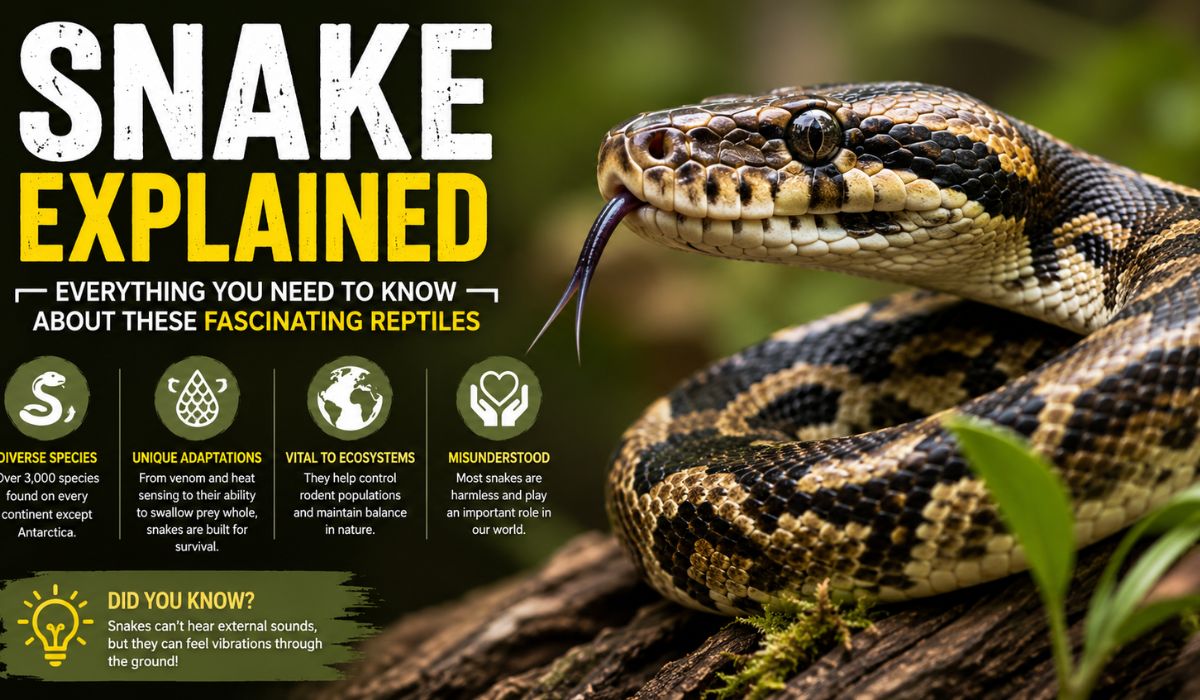
Snakes are among the most fascinating and misunderstood animals on Earth. Found on almost every continent, these legless reptiles have adapted to deserts, forests, oceans, and even mountains. While many people fear snakes, they play a very important role in keeping nature balanced. They control pest populations, help maintain ecosystems, and show some of the most unique biological adaptations in the animal kingdom. In this article, we will explore everything about Snake biology, behavior, evolution, and their relationship with humans in a simple and easy-to-understand way.
What Is A Snake
A Snake is a legless reptile belonging to the suborder Serpentes. It is part of the larger group of reptiles called Squamata, which also includes lizards. Snakes are cold-blooded animals, meaning they depend on the environment to regulate their body temperature. Their long, flexible bodies and lack of limbs are not a disadvantage but a powerful evolutionary adaptation that helps them move silently, hunt effectively, and survive in many environments.
Types Of Snake Around The World
Snakes come in a wide variety of species, with more than 4,000 known types worldwide. They are generally divided into venomous and non-venomous groups. Venomous Snake species such as cobras, vipers, and rattlesnakes use toxic venom to immobilize prey. Non-venomous Snake species like pythons and boas rely on constriction to overpower their food. Most Snake species are actually harmless to humans and avoid confrontation whenever possible.
Where Snake Live In The World
Snakes are incredibly adaptable creatures found on every continent except Antarctica. They live in forests, deserts, wetlands, grasslands, and even oceans. Sea Snake species are especially adapted for marine life and spend most of their time underwater. Snakes are absent from some isolated places like Ireland, Iceland, and New Zealand. Their ability to survive in diverse environments shows how successful their evolution has been over millions of years.
Snake Anatomy And Body Structure
The body of a Snake is uniquely designed for survival. It has a highly flexible skull that allows it to swallow prey much larger than its head. Instead of multiple small organs arranged side by side, Snake internal organs are arranged in a long, narrow layout. Most Snakes have only one fully functional lung, while the other is reduced or absent. Their entire body is covered in keratin-based scales that protect them and help with movement.
How Snake Move Without Legs
One of the most interesting features of a Snake is its movement. Even without legs, Snakes can move quickly and efficiently using different motion techniques. The most common is lateral undulation, where the body moves in S-shaped waves. Some Snakes use sidewinding to move across sand, while others use concertina movement in narrow spaces. Tree-dwelling Snakes can climb smoothly, and a few species like flying Snakes can even glide between trees.
What Snake Eat And How They Hunt
Snakes are carnivorous predators, meaning they eat only animal-based food. Their diet includes rodents, birds, frogs, fish, eggs, insects, and even other Snakes. Different Snake species use different hunting strategies. Some ambush prey silently, others chase it, and venomous species inject toxins to immobilize it. After capturing prey, Snakes swallow it whole because they cannot chew or tear food into pieces.
Snake Venom And Its Purpose
Snake venom is a modified form of saliva that helps in hunting and digestion. It is not meant for attacking humans but for immobilizing prey. Venom contains complex proteins that affect the nervous system, blood, or tissues of the victim. Neurotoxic venom affects the brain and nerves, hemotoxic venom affects blood flow, and cytotoxic venom damages tissues. Venom is delivered through specialized fangs that inject it deep into prey.
Snake Senses And Survival Skills
Snakes do not rely on a single sense but use a combination of powerful sensory systems. They use their forked tongue to collect scent particles from the air, which are analyzed by a special organ in their mouth called Jacobson’s organ. Some Snakes, like pit vipers, can detect heat from warm-blooded animals. Although they do not have external ears, Snakes can sense vibrations through the ground, helping them detect movement nearby.
Snake Reproduction And Life Cycle
Snakes reproduce through internal fertilization. Males use a special reproductive organ called hemipenes during mating. Some Snake species lay eggs, while others give birth to live young. In rare cases, certain Snakes can reproduce without fertilization through a process called parthenogenesis. After birth or hatching, young Snakes are fully independent and receive no parental care in most species.
Snake Evolution And Ancient Origins
Snakes evolved from lizard-like ancestors millions of years ago during the Jurassic or Cretaceous period. Fossil evidence shows that early Snakes once had small limbs, which gradually disappeared over time. Scientists believe Snakes may have evolved either from burrowing reptiles or aquatic ancestors. Genetic changes, especially in limb development genes, played a major role in making modern Snakes completely legless.
Snake And Humans Relationship
Snakes have a complex relationship with humans. While some Snake species are dangerous due to venom, most avoid humans and only bite when threatened. Snakebites can be serious, but medical treatment using antivenom has greatly improved survival rates. In many cultures, Snakes are symbols of power, healing, and transformation. They are also used in traditional practices, wildlife research, and sometimes kept as pets.
Interesting Facts About Snake
Snakes are full of surprising abilities. Some species can go months without eating after a large meal. Others can climb trees, swim in oceans, or even glide through the air. The largest Snake ever discovered, Titanoboa, could grow over 12 meters long, while the smallest species is only a few centimeters long. Snakes can also sense vibrations so precisely that they can detect movement from far away.
Conclusion
Snakes are remarkable reptiles that have evolved unique features allowing them to survive in almost every environment on Earth. From their flexible bodies and advanced hunting skills to their complex sensory systems, Snakes represent one of nature’s most efficient predators. While they are often feared, they play a vital role in maintaining ecological balance by controlling pest populations. Understanding Snakes helps us appreciate their importance and reduces unnecessary fear. In reality, Snakes are not just fascinating creatures but essential members of the natural world we all depend on.
Frequently Asked Questions About Snake
What Is A Snake In Simple Words
A Snake Is A Legless Reptile That Moves Using Its Flexible Body And Belongs To A Group Called Serpents. It Is A Cold Blooded Animal That Depends On Environment For Temperature Control.
Are All Snakes Dangerous To Humans
No, Most Snakes Are Not Dangerous. Only A Small Number Of Species Are Venomous And Pose A Risk To Humans. Most Snakes Avoid Contact And Prefer To Escape.
How Do Snakes Eat Without Chewing
Snakes Swallow Their Prey Whole Using Their Flexible Jaws. Their Skull Bones Move Freely, Allowing Them To Eat Animals Larger Than Their Head.
Why Do Snakes Shed Their Skin
Snakes Shed Their Skin To Allow Growth, Remove Old Damaged Layers, And Maintain Healthy Skin. This Process Is Called Molting Or Ecdysis.
How Long Can A Snake Live
Snake Lifespan Varies By Species. Some Small Snakes Live Around 10 To 15 Years, While Larger Species In Captivity Can Live Over 30 Years.
Do Snakes Hear Sounds
Snakes Do Not Have External Ears, But They Can Sense Vibrations Through The Ground And Their Body, Which Helps Them Detect Movement.
What Do Snakes Eat In The Wild
Snakes Eat A Variety Of Animals Including Rodents, Birds, Frogs, Fish, Eggs, And Sometimes Other Snakes Depending On Their Species.
Recommended For You: 123Movies Overview: Features, Popularity, And Internet Streaming Culture